SEO or Google Ads? Find the break before you pick the channel
Decide between SEO and Google Ads by reviewing visibility, page clarity, inquiry quality and follow-up. Find the next useful move for your Fort Myers business.
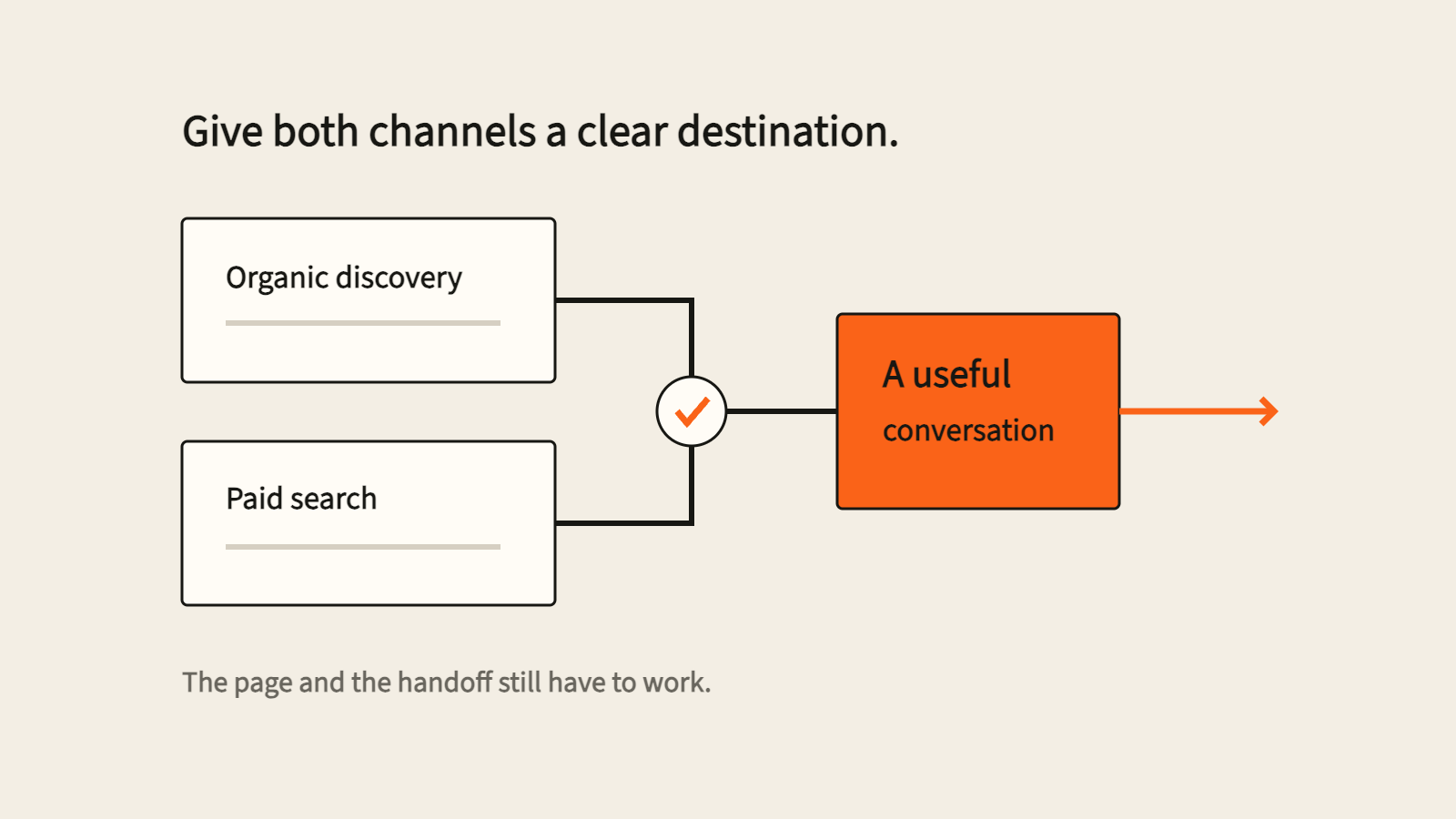
An owner can ask whether SEO or Google Ads is better and receive two convincing proposals that solve different problems. One promises to improve discovery. The other offers a way to reach people searching now. Neither tells you whether the website answers the customer’s question or whether the team handles the inquiries it already receives.
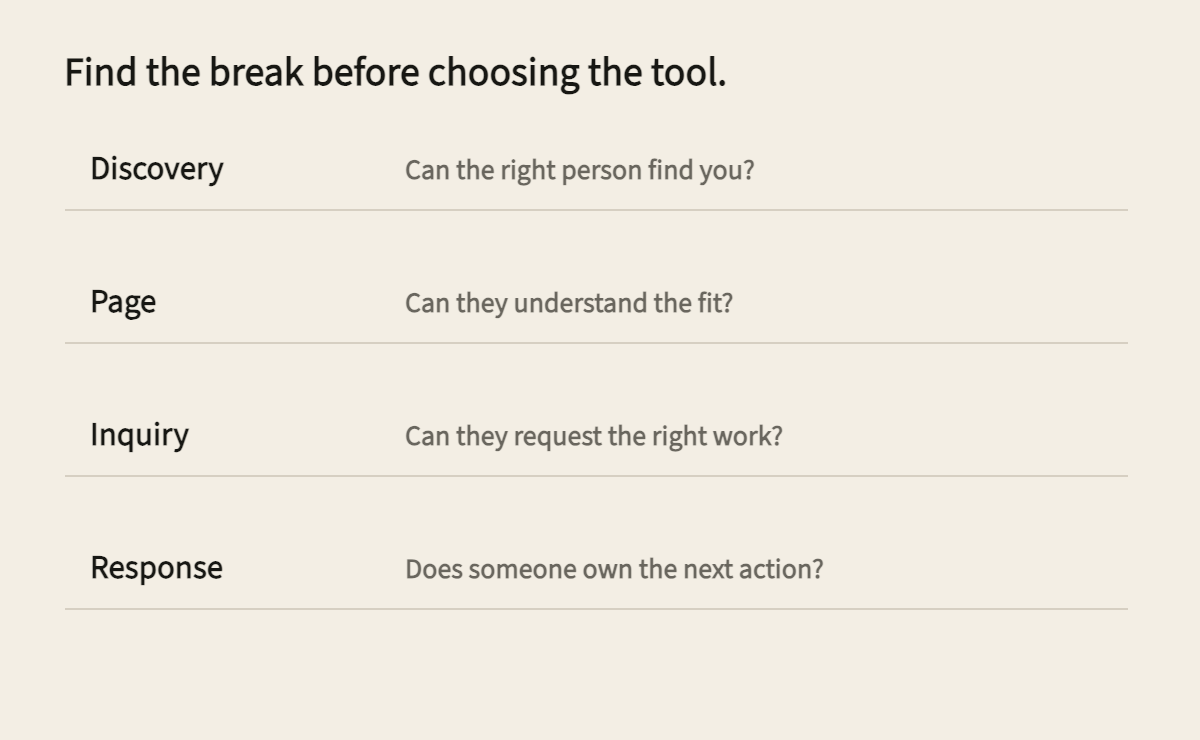
Choose the next channel only after locating the break between discovery, page, inquiry and customer conversation.
For a business serving Fort Myers, I would begin by locating the break between discovery and a useful customer conversation. A company that is hard to find has a different next decision from one that gets inquiries for work it does not accept. A company with unanswered requests has another problem again.
The channel decision becomes clearer when you can describe that break with evidence. You can then ask a provider to explain which part of the path it will change and how you will know whether the change helped.
Write down the problem in customer terms
“Marketing is not working” is too broad to direct the next action. Describe what the right customer is currently unable to do, or what is happening to the inquiries the business receives.
Useful starting statements include: relevant people cannot find the service; visitors arrive on a page that does not explain the work; requests come from locations the team does not serve; or accepted inquiries have no clear owner after submission. Treat these as questions to investigate until the records support them.
Choose one service to examine. A whole-company average can hide the distinction between a service with spare capacity and another the team cannot currently take on. It can also blend returning customers with people discovering the business for the first time.
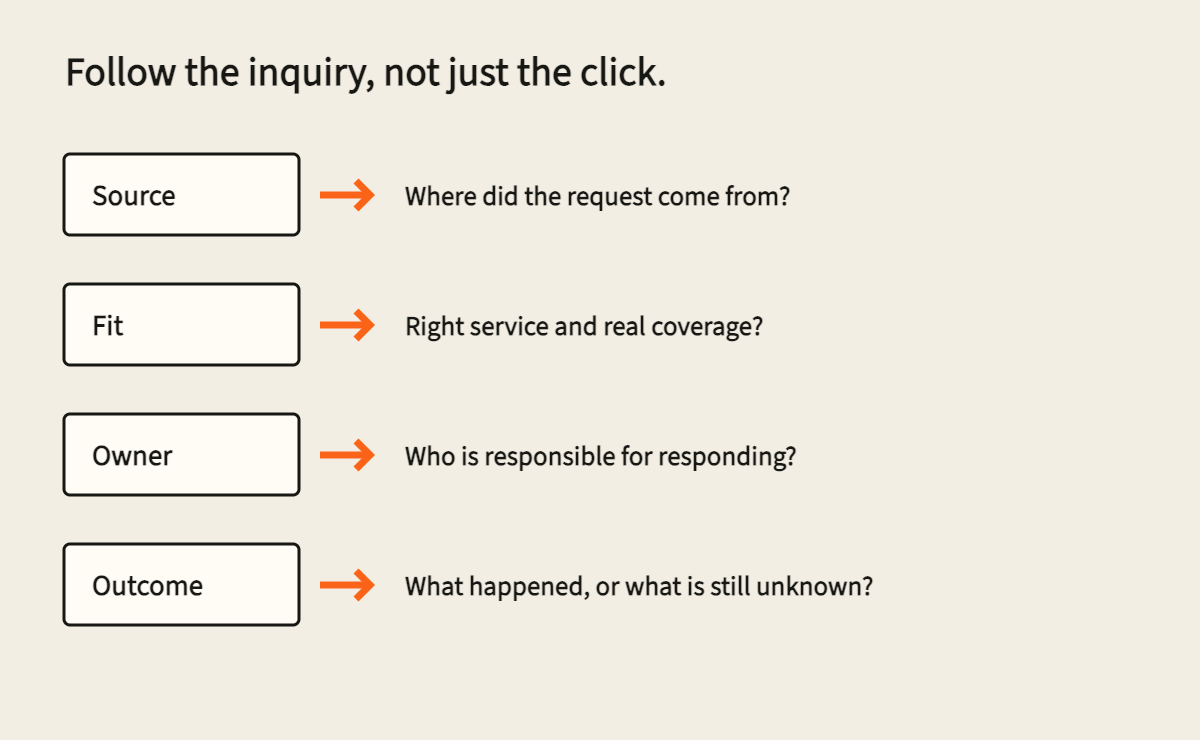
Read a defined period of available records. Separate calls, submitted forms, qualified inquiries, conversations and booked work. Keep unknown outcomes visible. A blank result should not quietly become a lost sale or a success, and a button click should not automatically become a qualified lead.
If the information is missing, establish the record before demanding a precise conclusion from it. The first useful piece of marketing work may be making the inquiry path observable.
Use SEO to strengthen relevant organic discovery
Local SEO is worth examining when the business genuinely serves the market but its public information, service pages or search presence do not communicate that clearly. The work may include accurate business information, useful service content and repairs to the technical path search engines use to reach the site.
For eligible businesses, Google says local results depend mainly on relevance, distance and prominence. It does not offer a payment option for better local rankings. The official local-ranking guidance gives you a useful boundary for evaluating an SEO proposal: the provider should explain the changes it controls without promising control over every result.
Ask what the proposal will improve. A plan to clarify a service page, fix an indexing problem or correct inaccurate profile information has an inspectable deliverable. A promise to “improve visibility” needs more detail before you can review it.
Also ask how the provider will distinguish branded discovery from searches for the service itself. Being found by someone who already knows the company and being considered by someone looking for a provider are different customer situations. Both matter, but the report should explain what it is showing.
There is no need to frame organic work as free. It requires content, implementation and maintenance. Nor should an owner assume that an organic result will remain unchanged indefinitely. Review the work as an ongoing business asset with a defined purpose, rather than a one-time position the provider can lock in.
Handers’ Fort Myers local SEO service follows that connected approach. Profile eligibility and truthful local evidence come first; the website still has to help the person who finds it.
Use search ads when the offer and destination are ready
Google Ads covers several campaign types and ad formats. This comparison is about paid search, where the immediate task is to connect relevant searches with an offer and a useful landing page. It is not a claim that every Google campaign behaves the same way; Google describes those differences in its campaign-format guidance.
Before considering a search campaign, establish the service you want to promote, the locations you can serve, the landing page and the inquiry process. Check that the team can take the kind of work the campaign is meant to attract.
The ad and page should agree on the customer’s task. If a person searches for a particular repair and reaches a general company homepage, they may still need to locate the relevant service. A focused page can explain the accepted work, real coverage, proof and next step together.
Google’s Quality Score documentation includes ad relevance and landing-page experience among its diagnostic components. It also explains that Quality Score itself is not a direct auction input. Use the official explanation to discuss relevance with the provider, rather than treating a score as a guaranteed business outcome.
The owner’s review should go beyond clicks. Ask which search terms produced the visits, whether the requests matched the service and area, and what happened after the team received them. Those questions connect the campaign to the operation.
A campaign proposal also needs a user-approved budget and a reason to continue, change or stop. Those figures should come from the business context and an evidence-backed estimate. A general article cannot supply a credible local cost per lead or profitable spend level for your particular service.
Fix the page or handoff when demand already reaches you
If relevant visitors reach the site but cannot establish fit, sending more people to the same page leaves the underlying question unanswered. If qualified requests arrive but the team does not handle them consistently, the next repair may belong after the form.
That does not prove every weak result is a website or response problem. It means those stages deserve examination before the channel takes all the blame.
Read the page alongside actual inquiry questions, with private customer information protected. If people repeatedly ask whether the company does a service the page is supposed to explain, that is a useful signal to investigate. Check whether the relevant information is present, understandable and easy to find on a phone.
Then follow an authorized test request through your own systems. Establish that it arrives, reaches the correct person and has a recorded next action. An automatic acknowledgment can confirm receipt. It should not be described as a completed sales conversation or a confirmed appointment unless that is what the system actually accomplishes.
The service-page checklist covers the destination. Handers’ marketing automation work covers routing and follow-up. They support demand generation, but each solves a different part of the problem.
Compare options against one operating record
Ask each provider to use the same description of the service, coverage, available capacity and inquiry outcomes. Otherwise, the proposals can sound comparable while resting on different assumptions.
| Evidence you have | Next investigation | What a useful deliverable could show |
|---|---|---|
| Relevant services are poorly explained or hard to discover | Organic search, profile accuracy and website content | Specific pages or business information corrected, with discovery changes measured separately |
| A clear service and working inquiry path need additional demand | Search campaign fit and current search opportunity | A defined campaign, matching page, approved spend boundary and inquiry-quality reporting |
| Visitors reach the right page but cannot establish fit | Service-page content and usability | Clear scope, coverage, relevant proof and a usable next action |
| Appropriate inquiries arrive but stall | Ownership, notification and follow-up | A verified route from request to accountable person and recorded next action |
| Reports count clicks but lose the inquiry outcome | Measurement and operational records | A traceable record that distinguishes visits, requests, conversations and booked work |
These are investigation routes, not automatic verdicts. For example, low inquiry volume alone does not prove weak discovery. You also need to understand the visits, service fit and ability to contact the business. A single metric rarely describes the whole path.
Keep each metric’s definition attached to it. An answered call can still be a wrong-number call. A booked appointment can still be unsuitable for the service. The business and provider need a common definition of a qualified inquiry before comparing campaign performance.
Three situations that lead to different decisions
Consider three illustrative situations. They are examples for making the decision, not accounts of Handers clients or predictions of campaign performance.
A home-service business has capacity for a specific job type, but its website describes only a broad category and the contact page gives no clear coverage information. I would clarify the service page and verify the inquiry path before buying more traffic for that service. The immediate deliverable is a better destination that can support either organic or paid demand.
A professional service has a clear page, accurate public information and a dependable way to handle requests. It wants to examine additional search demand for one defined offer. Paid search may be a useful route to evaluate, provided the owner approves the commercial boundaries and the campaign can be reviewed against inquiry quality. That does not remove the value of maintaining the website’s organic visibility.
A field-service team receives appropriate requests, but nobody can reliably say who owns them after submission. Some sit in a shared inbox; others are passed on without a status. I would establish responsibility and verify the handoff. A new advertising campaign could increase the number of requests exposed to the same failure.
The difference between these situations is the evidence and operational readiness. The city label alone cannot select the channel. For a company covering Fort Myers and surrounding communities, accepted service areas and capacity are inputs to the decision, not details to leave until after a campaign starts.
Ask for a testable next move
Bring a provider the chosen service, the page, the real coverage rules, the inquiry records you have and the outcome you need to improve. Ask for a specific next move: what will change, which assumption it tests and what evidence will inform the following decision.
You may end up with an SEO task, a focused search campaign, a page revision or a follow-up repair. You may need more than one, in a deliberate order. The useful proposal makes that order understandable and gives you something concrete to review.
If you want to examine the path together, book a call with Max. Bring the evidence you have, including the gaps. Handers’ connected marketing approach starts with locating the next useful fix.
Use this guide
Work through it with your AI assistant
Copy a prompt with the article, then paste it into the assistant you use.
Put this guide to work
Bring the current website, lead path, or workflow to a focused call. I will help identify the next practical move.
Book a call with Max
Written by
Max Tymoshyn
Marketing Expert at Handers Digital. I write field notes about Fort Myers websites, local visibility, conversion paths, and the systems that connect a click to a customer conversation.
About me and all articles