Local SEO in Fort Myers when you do not have a storefront
Plan local SEO without a storefront: check Google Business Profile eligibility, hidden-address rules, service areas and truthful website evidence.
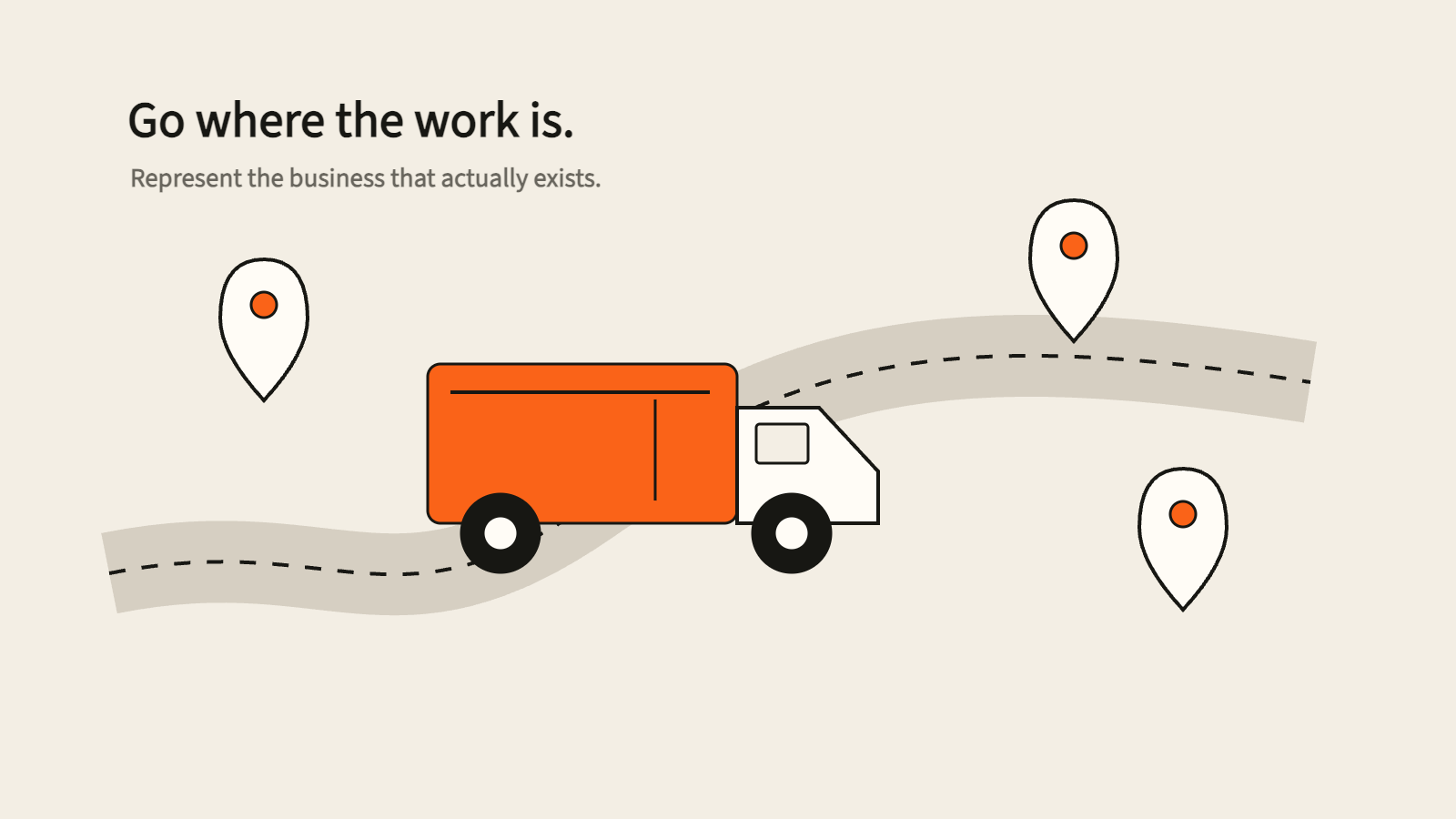
You can serve customers in Fort Myers without inviting them to an office. The important distinction is whether you meet customers in person, where that happens, and what your public business information claims.
A service-area business needs truthful eligibility and operating evidence, not an invented local address.
For a contractor, cleaner or mobile service that travels to customers, local visibility should reflect that operation. Renting an address for appearances does not establish the customer-facing premises a profile claims to represent. Nor does adding a city name to every page explain why someone in that city should choose the business.
I would separate the work into three decisions: establish whether the business qualifies for a Google Business Profile, describe the service area accurately, and build a website that helps customers assess the service. Each has a different evidence requirement.
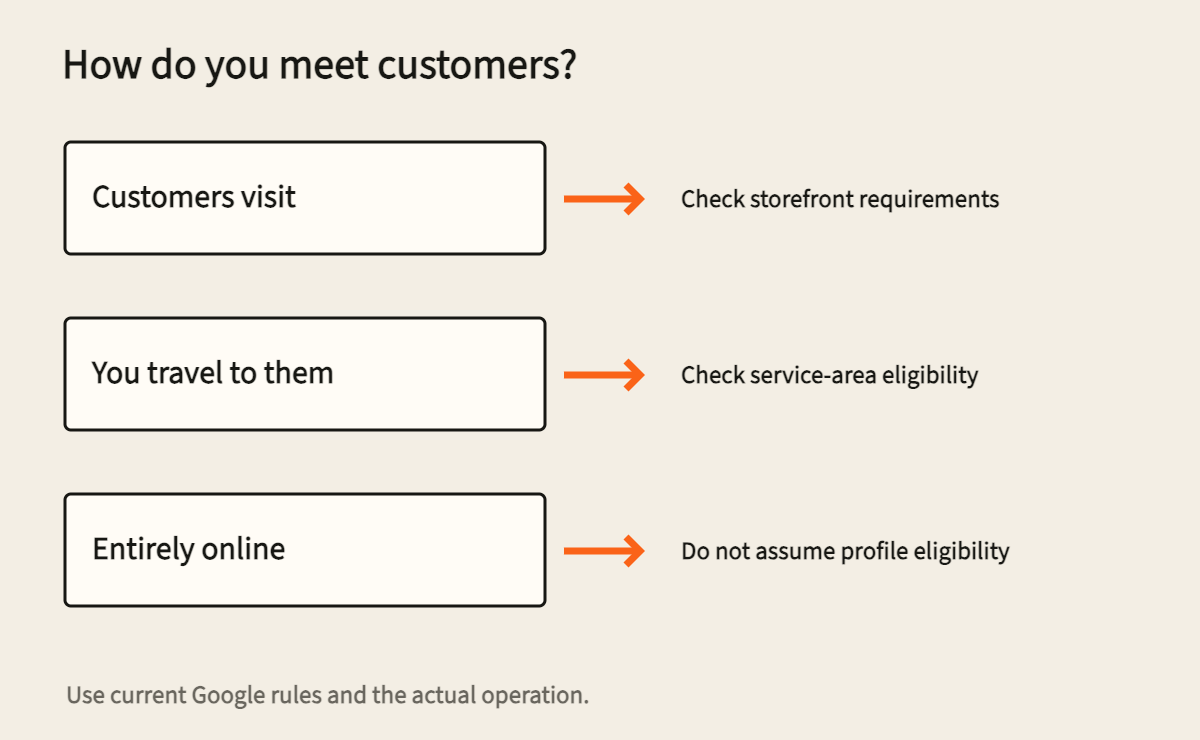
Start with how you actually meet customers
Google generally requires eligible businesses to make in-person contact with customers during their stated hours. Its eligibility guidance distinguishes eligible local businesses from online-only businesses and other excluded categories. A company serving Fort Myers entirely remotely should not assume that mentioning Fort Myers makes it eligible for a profile.
That is the first decision to resolve with the owner. Does the team travel to customers? Do customers visit an actual staffed business location? Does the operation do both? Or is the relationship entirely online?
The following is an owner’s decision aid, not an eligibility determination for a particular business. Industry-specific restrictions and the current Google rules still apply.
| Actual operation | The question to resolve | Public information should reflect |
|---|---|---|
| Staff travel to customers | Does the business qualify as a service-area business? | The real business and the area where it provides eligible in-person service |
| Customers visit a staffed location | Does the location meet the applicable storefront requirements? | The genuine customer-facing premises and its operating hours |
| Customers visit and staff also travel | Does the business meet the requirements for a hybrid operation? | Both its qualifying location and actual service area |
| All customer service is remote | Is the business excluded as online-only? | Its website and truthful service offer; no assumption of Maps eligibility |
Write the answer down before asking anyone to create or optimize a profile. A marketing provider needs the actual business model, not just the markets the owner would like to reach.
For example, an illustrative cleaning company that visits homes has a different operating model from an entirely remote advisory business. Both may sell to people in Lee County. That shared target market does not make their profile eligibility identical.
Keep the real address and public address distinct
An address used to establish the real business and an address displayed to customers serve different purposes. If customers do not visit the location, do not present it as a place where they can turn up for service.
Google’s business representation guidelines describe address, service-area and location requirements. A service-area business without a customer-facing storefront should hide its address from customers. A rented postal address or nominal virtual office is not a shortcut to a qualifying location; coworking premises have specific signage, staffing and customer-reception conditions.
The owner should retain accurate private business records for verification while choosing the public display according to the actual operation. Hiding an address is not permission to supply a fictional one to the platform.
Be careful with website copy as well. A location label, contact-page map or photograph of an office can imply a physical presence. If the business travels to Fort Myers from elsewhere, “serving Fort Myers” is a more accurate description than “our Fort Myers office.”
Handers uses that service-area distinction in its own Fort Myers SEO approach. The point is to explain where a business can help without borrowing a location it cannot substantiate.
A service area is an operating commitment
Select the communities where the business actually performs the service. The owner should be able to explain how coverage works when someone calls from any location in the list.
As checked on September 13, 2026, Google allows service areas to be described by cities, postal codes or other supported areas, with up to 20 areas. Its guidance says the overall boundary should generally remain within about two hours’ driving time of the business base. It does not offer a radius setting for editing the service area. See Google’s current service-area instructions before making changes.
Those limits are not a target to fill. The useful question is which area the team can serve reliably. Listing more places does not make an unavailable appointment available or turn one crew into several.
For an illustrative business serving Fort Myers, Cape Coral and Estero, build an internal coverage record. Note the services offered in each area, how appointments are arranged and who approves requests outside normal coverage. If one service has different availability, give the receiving team a rule for explaining it.
Use that record to inform the website. A customer should be able to understand whether to contact you and what needs confirmation. A long city list with no service explanation leaves the important question unresolved.
Build local evidence on the website
The website has room to answer questions a profile cannot address fully. Explain the service, the situations it is suitable for, the area served and the next step. Relevant evidence can include actual work, approved feedback and practical information about arranging the service.
An individual city page earns its place when it answers a distinct customer need. The owner should have something useful to say about the operation there. That might be different service availability, a documented project, specific access requirements or a separate customer-facing location. Use only facts the business can support.
If the only difference is that “Fort Myers” becomes “Cape Coral,” I would keep the information on a stronger shared service page until there is a real reason to separate it. This is an editorial recommendation about usefulness, not a promise that a particular page structure will rank.
An example clarifies the difference. An illustrative contractor has completed a job in a community and has permission to show it. A page explaining the work, the customer problem and the service available nearby gives a visitor evidence to consider. A generic paragraph with the city name inserted gives them much less to assess.
Do not confuse useful local evidence with local decoration. A skyline image, neighborhood list or reference to a familiar landmark may create atmosphere, but it does not establish service experience. If a detail does not help the customer understand the work or the operating area, it may not need to be there.
The service-page checklist turns those decisions into a brief you can give a writer or designer. It also helps keep the page connected to a real inquiry process.
Separate Maps from organic website visibility
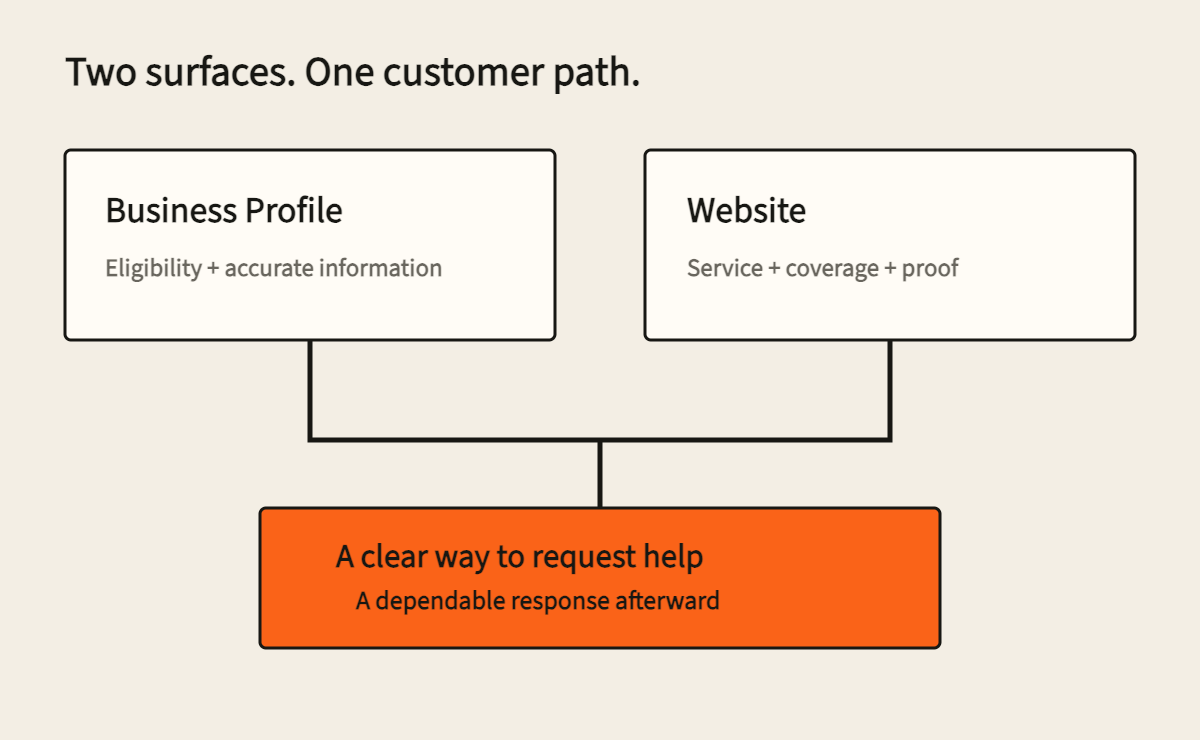
A Business Profile and a website are different search surfaces. Keep their measurements separate so a single ranking screenshot does not become a report on the entire business.
Google identifies relevance, distance and prominence as major local-ranking factors. Distance concerns the business’s relationship to the person searching. Google also states that businesses cannot pay for a better local ranking. Its local-ranking explanation is a useful check against promises of guaranteed Maps coverage.
My recommendation is to ask a provider to specify what it measured: the query, the search location, the date and the result type. A website result for a service query is different from a Maps placement. One observation from one location does not establish visibility across every community the business serves.
Then connect visibility to a customer action. A relevant person may find the business and still leave because the service is unclear. A qualified inquiry may arrive and still go unanswered. Keep the report tied to the part of the path under review.
Keep one consistent business record
Create a small, owner-controlled record of the facts a provider may use: the real business name, website, phone number, public address status, service areas, operating hours and appropriate account owners. Keep private verification documents out of public marketing materials.
When the operation changes, use that record to review the affected public surfaces. A new service area may require a website update and a profile review. A changed phone number needs its links and receiving workflow checked. A change in hours should not leave one channel promising service the team no longer provides.
This is maintenance of business facts. It should not become an exercise in changing small punctuation differences everywhere while more serious errors remain. I would first repair information that could send someone to the wrong place, wrong number or wrong expectation.
Make access ownership explicit. The business should know which account controls its profile and who can make changes. A provider’s involvement should not leave the owner uncertain about how to review the work or regain control of an asset.
An owner’s preflight before profile changes
Before a provider starts, have four things ready: a description of how customers are served, an accurate private business record, a public service-area statement and a website page that explains the actual service. Have them identify the relevant Google rule when they recommend an eligibility or address change.
A good next action may be correcting the public information. It may be documenting a real operation more clearly. It may also be accepting that a remote business should pursue website visibility without claiming a qualifying storefront or service-area profile.
That decision should come before a package of promised rankings. If you need help reviewing the profile and website together, book a call with Max. Bring the actual operating model and the pages customers currently see.
Use this guide
Work through it with your AI assistant
Copy a prompt with the article, then paste it into the assistant you use.
Put this guide to work
Bring the current website, lead path, or workflow to a focused call. I will help identify the next practical move.
Book a call with Max
Written by
Max Tymoshyn
Marketing Expert at Handers Digital. I write field notes about Fort Myers websites, local visibility, conversion paths, and the systems that connect a click to a customer conversation.
About me and all articles